
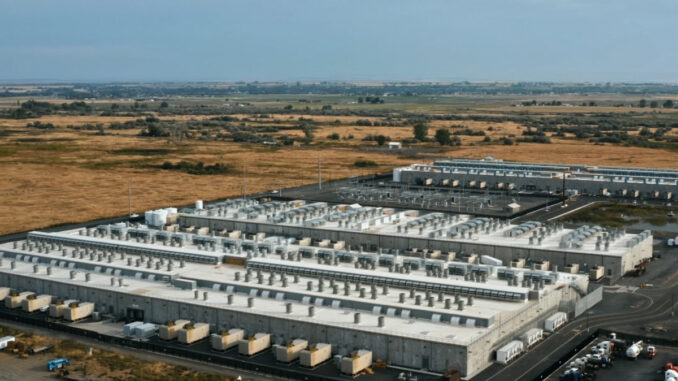
Community Impact Summary: What the Cooling System Noise Really Means for People Living Near a Hyperscale AI Data Center
The newest artificial intelligence computer chips run so hot that the cooling systems required to keep them from overheating have grown into full-scale industrial operations — and those operations are loud.
To cool a building packed with these chips, massive refrigeration units, large circulating pumps, and banks of condenser fans must run continuously, 24 hours a day, seven days a week, with no scheduled breaks or quiet periods. At the roofline of the building where all of this equipment sits, the combined noise level typically ranges from 85 to 100 decibels — roughly the same volume as standing next to a busy highway or a large factory floor. That noise does not stay at the building. It travels outward, and in the wide-open, quiet landscape of central Wyoming, it can still measure 45 to 55 decibels at half a mile away — about the same as a vacuum cleaner running in the next room heard through a closed door.
Even more concerning is the low-frequency portion of that sound, the deep, steady hum produced by compressors and pumps that cannot be picked up reliably by standard noise meters. Low-frequency sound travels farther than higher-pitched noise, passes through walls more easily, and is known to cause headaches, disrupted sleep, nausea, and chronic stress in people exposed to it over time. Central Wyoming’s flat terrain, calm nighttime winds, and frequent temperature inversions — conditions where cooler air traps sound close to the ground instead of letting it rise and scatter — make this region particularly vulnerable to noise traveling well beyond the facility fence line.
For residents living within a mile or more of a proposed facility, this is not background noise that fades into the environment. In an area where natural nighttime quiet can measure as low as 20 to 30 decibels, a continuous industrial hum at 45 to 55 decibels is clearly audible, persistent, and for many people, impossible to ignore.
The thermal demands placed on hyperscale data center cooling infrastructure have outpaced the engineering assumptions embedded in most currently proposed closed-loop systems. NVIDIA’s B300 GPU draws up to 1,400 watts per chip in the GB300 NVL72 rack configuration — double the H100, which shipped barely two years ago. The H100 operates at 700W TDP, the B200 increases that to 1,000W TDP, and GB300-class hardware pushes per-chip heat output to 1,400W. A full rack of H100 servers yields roughly 50 kW of heat; the GB200 NVL72 rack generates 120 to 140 kW. Industry projections warn AI racks may approach 1 MW within the next few years, far beyond the capacity of legacy cooling schemes.
Direct-to-Chip Architecture and Cold Plate Constraints
In a direct‑to‑chip liquid cooling system, each processor is attached to a cold plate that transfers heat into a closed secondary loop containing the water–propylene glycol coolant. That warmed coolant does not travel directly to the rooftop refrigeration. Instead, it flows to an in‑hall plate heat exchanger inside a Coolant Distribution Unit (CDU).
There, heat is transferred into a separate primary facility loop, which carries the thermal load out of the data hall to the building’s external refrigeration plant. The rooftop or outdoor equipment—such as chillers, dry coolers, or adiabatic units—rejects the heat to the atmosphere and returns cooled primary‑loop fluid back to the CDU, which in turn cools the secondary chip loop before it re‑enters the cold plates.
The GB200 NVL72 reference specifications call for inlet temperatures of 68 to 77°F, flow rates around 21 gallons per minute, and pressure drop below 21.8 psi. NVIDIA’s newest chips do not permit higher operating temperatures to compensate for reduced cooling capacity — junction-temperature limits remain tightly constrained. As chip thermal output rises, higher flow rates and greater heat-rejection capacity become non-negotiable. The thermal density shift at B200 and GB200 NVL72 scale is not an incremental challenge — it is a category change that demands new facility design parameters and procurement specifications written to a precision standard most industrial cooling programs have not previously required.
Coolant Chemistry: Propylene Glycol’s Performance Trade-Off
Ethylene glycol that you run in your car provides 10 to 15 percent better heat transfer efficiency than propylene glycol, with higher thermal conductivity, higher density, and lower viscosity. Propylene glycol — preferred for its lower toxicity — has higher viscosity, requires more pumping power, and delivers weaker thermal performance, especially at lower temperatures. In a cooling loop already operating at the margins of thermal capacity with GB300-class chips, this efficiency gap translates directly into elevated pump loads and increased mechanical noise as the circulation system works against greater hydraulic resistance. When a system must reject twice the heat of a prior generation while using a less efficient transfer fluid, the compounding effect falls entirely on the rooftop refrigeration plant.
Altitude Derating, Rooftop Load, and Noise
At elevations characteristic of central Wyoming — where Casper sits at approximately 5,100 feet above sea level — air-cooled refrigeration equipment operates under reduced atmospheric pressure and lower air density. Refrigeration capacity losses of 10 to 25 percent are common at these elevations. Chillers compensate by running harder and longer, elevating both energy consumption and acoustic output from compressors, condenser fans, and circulation pumps simultaneously. A facility designed around H100-era heat loads will face a structural mismatch if reequipped with Blackwell Ultra hardware without corresponding upgrades to heat-rejection capacity and flow rates — and every upgrade to heat-rejection capacity adds directly to the rooftop noise load.
Air-cooled chillers, cooling towers, and rooftop air handling units produce noise levels of up to 100 dBA at the equipment face. The combined output of coolant transfer pumps, condenser fans, and refrigerant compressors at the roofline of a high-density AI facility typically falls in the 85 to 100 dBA range — comparable to sustained industrial plant noise. In a low-ambient environment where nighttime background levels measure 20 to 30 dBA, residual noise reaching 45 to 55 dBA at half a mile represents a significant intrusion. Temperature inversions common in high-plains Wyoming channel rooftop noise along terrain rather than dispersing it vertically, extending the acoustic footprint well beyond standard propagation models. Low-frequency sound generated by compressors and pumps passes through walls, travels farther than higher-pitched noise, and falls below the reliable detection thresholds of standard A-weighted measurement — making conventional noise ordinance language an inadequate safeguard for affected communities without the addition of octave band and C-weighted decibel limits.
Regulatory and Engineering Implications
Proposed data center systems engineered against H100-era heat outputs face measurable performance gaps when operating GB300-class hardware at high elevation with propylene glycol as the primary heat transfer fluid. Engineers with direct hyperscale cooling experience have noted that proposed systems for high-elevation sites may not support the thermal demands of halls populated with B200 or GB300-class chips without major redesigns: larger chillers, increased pumping capacity, and cold plates with significantly lower thermal resistance. Each of those upgrades adds to the acoustic load on the rooftop plant — and extends the noise footprint into surrounding areas.
References
- Barrack AI. “B300 Draws 1,400W Per GPU. Most Data Centers Aren’t Ready.” March 2026. https://blog.barrack.ai/nvidia-b300-1400w-data-center-requirements/
- IntuitionLabs. “NVIDIA HGX Platform: Data Center Physical Requirements Guide.” March 2026. https://intuitionlabs.ai/articles/nvidia-hgx-data-center-requirements
- Alliance Chemical. “GPU Thermal Density and Coolant Flow Specs: B200, GB200, and MI300.” April 2026. https://alliancechemical.com/blogs/articles/gpu-thermal-density-b200-gb200-coolant-flow-specs
- Clarifai. “NVIDIA B200 vs. H100: Choosing the Right GPU for Your AI Workloads.” January 2026. https://www.clarifai.com/blog/nvidia-b200-vs-h100
- Dober Performance Fluids. “Glycol for Direct-to-Chip Cooling in Data Centers.” April 2026. https://www.dober.com/performance-fluids/resources/glycol-data-center-cooling
- Alliance Chemical. “Ethylene Glycol vs Propylene Glycol: Antifreeze Comparison Guide.” June 2023. https://alliancechemical.com/blogs/articles/chilling-tales-of-ethylene-glycol-vs-propylene-glycol
- Dynalene, Inc. “Propylene Glycol vs. Ethylene Glycol.” March 2025. https://www.dynalene.com/propylene-glycol-vs-ethylene-glycol/
- EAI Water. “Comparing Ethylene Glycol vs Propylene Glycol.” February 2026. https://eaiwater.com/ethylene-glycol-vs-propylene-glycol/
- Data Center Knowledge. “What Are the 5 Main Causes of Noise in Data Centers?” April 2025. https://www.datacenterknowledge.com/data-storage/what-are-the-5-main-causes-of-noise-in-data-centers-
- Ketchum & Walton Co. “5 Sources of Noise in Data Centers.” January 2025. https://ketchumandwalton.com/5-sources-of-noise-in-data-centers-how-to-control-it/
- Environmental and Energy Study Institute (EESI). “Communities Are Raising Noise Pollution Concerns About Data Centers.” March 2026. https://www.eesi.org/articles/view/communities-are-raising-noise-pollution-concernsabout-data-centers
- Center for Environmental Data Solutions (CEDS). “How to Protect Your Home from Data Center Impacts.” December 2024. https://ceds.org/datacenter/
- Chiller Systems Service. “The Effect of High Altitude on HVAC Systems.” July 2024. https://chillersystemsservice.com/blog/high-altitude-hvac/
- Tom’s Hardware. “The Data Center Cooling State of Play (2025).” December 2025. https://www.tomshardware.com/pc-components/cooling/the-data-center-cooling-state-of-play-2025
- Data Centre Magazine. “How Closed-Loop Cooling Is Reshaping Data Centre Design.” February 2026. https://datacentremagazine.com/news/how-closed-loop-cooling-is-reshaping-data-centre-design
- H2O Cooling. “2026 Data Center Cooling Solutions.” February 2026. https://h2ocooling.com/data-center-cooling-solutions/
- PHCPP Pros. “Hyperscale Data Centers Can Save Water and Energy.” https://www.phcppros.com/articles/14348-hyperscale-data-centers-can-save-water-and-energy
Wyoming Data Center Facts | Photo: Microsoft