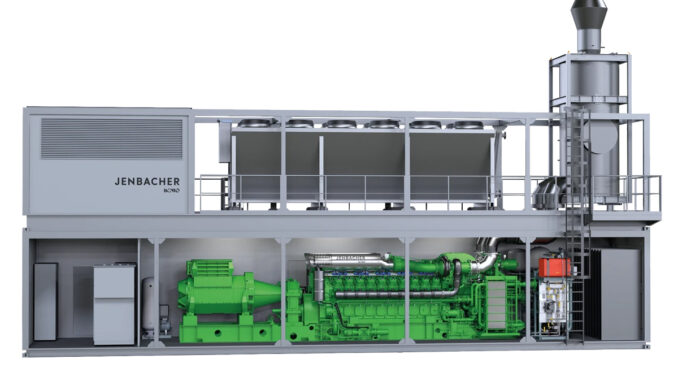
500 MW Jenbacher J620 Generator Field — Community Impact Summary
A cluster of roughly 150 Jenbacher J620 school-bus-sized natural gas engines — the kind now being proposed to power hyperscale AI data centers near Casper — would burn 31–33 billion cubic feet of natural gas every year—more than twice the amount used by all the homes in Wyoming in one year combined, while releasing 1.7 to 1.9 million tons of carbon dioxide annually, equal to the exhaust from nearly 400,000 cars, trucks, and SUVs running year‑round—well over half of all the passenger vehicles in Wyoming.”
On top of CO₂, the engines would emit regulated air pollutants, including smog-forming nitrogen oxides, carbon monoxide, volatile organic compounds, formaldehyde, and fine particulate matter at levels that, under federal Clean Air Act rules, classify the installation as a major industrial pollution source regardless of what emission controls are installed.
The noise picture is equally significant: at half a mile from the engine farm, sound levels would run in the range of a busy highway — but unlike a highway, the noise never stops, day or night, seven days a week, 365 days a year.
More concerning than the audible noise is the low-frequency energy these engines produce in the 20 to 40 Hz range — a deep, persistent rumble and vibration generated by 150 large pistons firing in overlapping cycles. This type of low-frequency sound travels much farther than ordinary noise, passes straight through walls and windows, cannot be blocked by standard sound barriers, and couples into the ground, where it can be felt as vibration rather than heard as sound.
In the hard, dry geology of the Casper–Glenrock basin, where shallow bedrock carries vibration efficiently and nighttime atmospheric conditions push sound back toward the ground rather than letting it dissipate upward, that rumble and ground vibration would be detectable — and for many residents, physically noticeable — at distances well beyond two miles from the installation.
A technology marketed as a cleaner, faster alternative to diesel backup power is being deployed at a scale that regulators, environmental advocates, and acoustical researchers say transforms its environmental profile entirely. Arrays of 150 or more Jenbacher J620 natural-gas reciprocating engines — each producing up to 3.36 megawatts — are emerging as the preferred onsite generation strategy for hyperscale artificial intelligence data centers unable to secure sufficient utility power. The result, based on manufacturer performance data, federal emissions methodology, and acoustic propagation modeling, is the functional equivalent of a mid-sized fossil-fuel power plant built in pieces and placed closer to people.
The Scale Problem
The J620 is the Jenbacher Type 6 family’s primary workhorse, a V20-cylinder solution with electrical output of up to 3,360 kW and electrical efficiency up to 45.9 percent. The J620 fast-start variant reaches full 3-megawatt output in under 45 seconds, a capability designed specifically for data center applications.
Those per-unit figures, however, change substantially when arrayed at hyperscale. To supply 500 megawatts of continuous output — a load consistent with what Prometheus Hyperscale is proposing for it’s 500MW campuse — approximately 149 J620 units would be required, based on the engine’s nameplate rating of 3.36 MW. Using the U.S. Energy Information Administration’s standard natural gas energy content of 1.037 MMBtu per thousand cubic feet, and applying a heat rate derived from the J620’s 45.9 percent electrical efficiency, a 500 MW installation operating at baseload would consume roughly 31 to 33 billion cubic feet of natural gas per year. Applying the EPA’s standard combustion emission factor of 117 pounds of CO₂ per MMBtu yields annual CO₂ output of approximately 1.7 to 1.9 million tons — roughly equivalent to the annual tailpipe emissions of 380,000 to 400,000 light-duty vehicles. According to EPA vehicle data, that figure represents more than half of Wyoming’s entire registered light-duty fleet.
Wyoming as a Deployment Zone
Wyoming has emerged as a focal point for this buildout. Prometheus Hyperscale, a Wyoming-based developer, has proposed a 1.5-gigawatt liquid-cooled data center campus approximately 9 miles east of Casper on the Falls Ranch property, straddling the Natrona–Converse county line. The company’s founder has confirmed that the facility will initially be powered by Jenbacher natural-gas reciprocating engines.
In Laramie County, commissioners in January voted to approve Project Jade, an AI data center campus proposed by Crusoe Energy Systems, alongside the BFC Power and Cheyenne Power Hub — a 2.7 GW natural gas generation project by Tallgrass Energy representing a $7 billion energy infrastructure investment alone, with total campus capital expenditure estimated above $50 billion. The Cheyenne campus is designed to scale to as much as 10 GW of capacity, which would require additional generation resources.
Wyoming Business Council officials have noted that grid constraints outside Cheyenne are a persistent problem, with many communities along the I-80 corridor capable of supporting only 20 to 50 megawatts — far below the power requirements of large-scale AI data centers. That gap between available utility capacity and hyperscale demand is precisely what reciprocating engine farms are designed to fill.
Air Quality and the Permitting Gap
The combustion emissions profile of a 150-unit engine array places it squarely within the definition of a major stationary source under the Clean Air Act. Under New Source Review, pollutant-emitting activities are aggregated into a single stationary source when they share the same SIC code, are under common control, and are located on contiguous or adjacent properties — meaning whether a data center and its co-located power plant are treated as one source can determine whether their combined emissions trigger major NSR and PSD thresholds.
That question has played out publicly in the xAI case in Tennessee. The Southern Environmental Law Center and Earthjustice, representing the NAACP, filed suit alleging xAI violated the Clean Air Act by installing and operating natural gas turbines at its Colossus 2 data center in Southaven, Mississippi, without permits, with the potential to emit more than 1,700 tons of NOx per year — likely making it the largest industrial NOx source in the greater Memphis area, which already fails to meet national smog standards.
The federal regulatory response has been strong in many cases. In January 2025, EPA finalized rules stating that temporary or portable large power generators — specifically gas turbines — cannot avoid Clean Air Act standards by claiming mobile-source status, and that permitting would fall under federal law rather than local or state guidelines.
Noise and Low-Frequency Vibration
Criteria pollutants are not the only community-scale concern. Large reciprocating engines generate broadband mechanical noise and sustained low-frequency energy — typically in the 20 to 40 Hz range — that behaves differently from conventional industrial sound. Low-frequency sound generated by combustion processes, cogeneration units, and large diesel and gas engines propagates over relatively large distances with strong energy retention, and exposure has been associated with difficulty performing mental tasks and physical discomfort.
Acoustic scaling calculations, based on standard spherical spreading models and Jenbacher containerized unit specifications, indicate that a 149-unit J620 array would produce A-weighted sound levels of approximately 57 to 62 dB(A) at half a mile from the array boundary, declining to roughly 45 to 50 dB(A) at two miles. Those levels are consistent with a distant freeway — but sustained continuously, 24 hours a day, in rural or low-ambient-noise environments where background levels may fall below 30 dB(A) at night.
Low-frequency content compounds the problem. Unlike higher-frequency noise, sub-50 Hz energy experiences minimal atmospheric absorption, couples efficiently into hard or dry ground, and penetrates building structures. Out-of-phase operation of approximately 150 engines produces a broadband low-frequency rumble with beats and amplitude modulation that standard A-weighting does not fully capture.
In the Casper–Glenrock basin, where shallow bedrock and dry alluvium reflect and transmit low-frequency vibration, and where nighttime temperature inversions regularly bend sound back toward the ground, the propagation envelope extends further than standard open-field calculations would suggest. Low-frequency noise and infrasound from reciprocating machinery and combustion sources can be characterized across the 20 to 200 Hz range, with effects at frequencies below 20 Hz evaluated using G-weighting per ISO 7196.
Land Use and the Industrial Footprint
A 500 MW J620 installation requires engine halls or containerized rows, gas conditioning and compression equipment, high-capacity substations, radiator banks or cooling towers for thermal rejection, access roads, and safety setbacks. Total site area typically exceeds 20 to 40 acres, depending on layout and noise mitigation requirements. Each engine also rejects substantial thermal energy, contributing to localized heat loading and potential microclimate effects within the immediate installation perimeter.
Wildlife habitat disruption extends far beyond the fence line of a generator farm. The acoustic, vibrational, and thermal footprint of 24‑hour natural‑gas engine arrays alters the ecological function of surrounding habitat. Continuous low‑frequency vibration, broadband mechanical noise, and nighttime industrial lighting interfere with the foraging, movement, and nesting behavior of deer, pronghorn, raptors, prairie species, bald and golden eagles, and migratory bird populations.
These effects are well‑documented in wildlife biology, yet they receive minimal consideration in standard air‑quality permitting, which focuses almost exclusively on emissions. In contrast, state game and fish agencies routinely evaluate these same disturbance factors—noise, vibration, lighting, and thermal plumes—because they directly influence habitat suitability, reproductive success, and long‑term population stability.
Wyoming and federal officials will be watched closely to ensure that all required studies are completed thoroughly for a project of this magnitude, leaving no room for regulatory gaps. Large natural gas engine farms operate as continuous disturbance sources, not intermittent industrial facilities, and their full ecological footprint—noise, low‑frequency vibration, lighting, thermal output, and habitat disruption—must be evaluated with the same rigor applied to any major energy infrastructure project. Oversight agencies will be expected to ensure that permitting frameworks fully account for the cumulative impacts these generator arrays impose on surrounding communities and wildlife habitat.
References
- INNIO Jenbacher. J620 Gas Engine Technical Specifications. jenbacher.com/en/gas-engines/type-6/j620
- INNIO Jenbacher. J620 Fast Start — Data Center Applications. jenbacher.com/en/gas-engines/type-6/j620-fast-start
- INNIO Group. INNIO Launches Fast-Start 3-Megawatt Natural Gas Generator Solution for Data Centers. Press release. innio.com, 2023.
- INNIO Group. Jenbacher Engine Technology Delivering the Power Needs of North America’s Data Centers. innio.com/en/news-media/magazine
- INNIO Group. Jenbacher Engines to Power 60 MW Hyperscale Data Center Power Plant in Ireland. Press release, September 2024.
- INNIO Group. Data Center Solutions for North America — White Paper. jenbacher.com (PDF)
- U.S. Energy Information Administration. Natural Gas Explained — Energy Content. eia.gov
- U.S. EPA. Emission Factors for Greenhouse Gas Inventories — Natural Gas (Stationary Combustion). 117 lb CO₂/MMBtu. epa.gov
- U.S. EPA. AP-42, Chapter 3.2: Natural Gas-Fired Reciprocating Engines. epa.gov
- U.S. EPA. Greenhouse Gas Equivalencies Calculator — Passenger Vehicles. 4.6 metric tons CO₂/vehicle-year. epa.gov
- U.S. EPA. Clean Air Act Resources for Data Centers. epa.gov, December 2025.
- U.S. EPA. New Source Performance Standards Review for Stationary Combustion Turbines. Federal Register, January 15, 2026. 40 CFR Part 60.
- Gibson Dunn. EPA Launches Clean Air Act Resource for Data Centers. gibsondunn.com, December 2025.
- Jackson Walker. EPA Launches Clean Air Act Resource Hub for Data Center Developers. jw.com, January 2026.
- A&WMA / Inside EPA. EPA Moving To Regulate Some Data Center Turbines As ‘Mobile Sources.’ awma.org, April 2026.
- Southern Environmental Law Center. xAI Built an Illegal Power Plant to Power Its Data Center. selc.org, 2026.
- Encino Environmental Services. Minimizing Data Center Emissions for Simplifying Permitting. encinoenviron.com, 2025.
- International Energy Agency. Key Questions on Energy and AI. iea.org, April 2026.
- International Energy Agency. Energy and AI — Energy Demand from AI. iea.org, 2025.
- Pew Research Center. What We Know About Energy Use at U.S. Data Centers Amid the AI Boom. pewresearch.org, October 2025.
- Norton Rose Fulbright. Data Centers and Natural Gas. projectfinance.law, August 2025.
- Cleanview / Energy News Beat. Nearly 75% of Planned On-Site Power at US Data Centers Is Natural Gas. energynewsbeat.co, February 2026.
- POWER Magazine. Wyoming Approves Data Center Campus That Includes 2.7 GW of New Natural Gas-Fired Generation. powermag.com, January 2026.
- Crusoe Energy / Tallgrass Energy. Crusoe and Tallgrass Announce AI Data Center in Wyoming. crusoe.ai, July 2025.
- Carbon Herald. Wyoming Lands 1.8-Gigawatt AI Data Center Powered By Gas and Carbon Capture. carbonherald.com, August 2025.
- Oil City News (Casper, WY). Large Data Center Proposed Near Casper. oilcity.news, May 2026.
- Cowboy State Daily. Cheyenne to Get Massive AI Data Center Powered by Gas and Carbon Capture. cowboystatedaily.com, July 2025.
- Data Center Dynamics. Prometheus Hyperscale to Power Wyoming Data Center with Natural Gas, Will Offset Through Carbon Capture. datacenterdynamics.com, 2026.
- Leventhall, H.G. A Review of Published Research on Low Frequency Noise and Its Effects. UK Department for Environment, Food and Rural Affairs, 2004.
- ScienceDirect / Applied Acoustics. Impacts of Low-Frequency Noise from Industrial Sources in Residential Areas. Vol. 182, 2021.
- ResearchGate / Slovak University of Technology. Low Frequency Sound Generated by Industrial Equipment and Its Negative Impact on Human Health. 2024.
- PMC / NCBI. Analysis of Noise Generated by Wind Turbines With Reference to Other Low Frequency Noise Sources and Their Possible Impact on Human Health. 2025.
- USGS / Wyoming State Geological Survey. Geologic mapping of central Wyoming (Natrona and Converse Counties).
- ISO 7196:1995. Acoustics — Frequency-Weighting Characteristic for Infrasound Measurements (G-Weighting).
Wyoming Data Center Facts Staff | Photo: Jenbacher