
By Jase Wilson – Published Nov 28, 2025
Today’s AI frenzy fuels a capital expenditure bubble of historic proportions. While mega-cap tech giants possess the balance sheets to survive a contraction, the real pain awaits the physical economy that is currently overbuilding the single-use “islands of Capex” serving this boom: hyperscaler data centers.
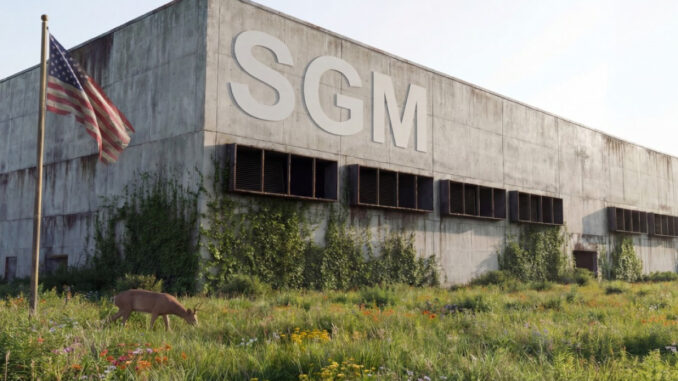
We are actively building massive, expensive, bespoke structures dedicated to a specific moment in history. These digital temples risk rapid obsolescence.
It is becoming plausible that a convergence of forces will play out against the builders, operators and owners of these single-purpose, limited lifespan facilities. Beyond a seemingly-imminent valuation correction, we will need to confront deep, structural problems with the physical assets themselves.
TLDR: 🚩🚩🚩s
🚩 1. The Training Cliff Training is temporary; inference is forever. As models plateau, the massive compute farms built for training become redundant. Inference (usage) is already migrating to the edge, leaving centralized facilities without clear long-term purpose.
🚩 2. The Supply Glut We are witnessing the fastest construction wave in U.S. history. Bloomberg data shows data center construction passes commercial real estate construction this year. Supply is outpacing demand by an order of magnitude. As this flood of capacity hits the market, Revenue-per-MW will crash.
🚩 3. Stranded Capex These are single-purpose assets. A data center built for AI training cannot be easily repurposed for standard real estate or even general cloud storage without retrofitting costs that exceed the initial build. They are effectively zombie buildings.
🚩 4. The Power Gap A significant percentage of “online” capacity is actually a mirage. Facilities are being built today that will sit idle for years waiting for grid connections that utilities cannot provide.
🚩 5. Depreciation Magic Hyperscalers are depreciating 3-year lifespan GPUs over 6–8 years to artificially inflate net income. It’s an accounting trick to hide the fact that the hardware is obsolete before it’s paid for.
🚩 6. Silicon Collateral Billions in debt are currently secured by GPU hardware. Lenders are accepting collateral that loses ~50% of its value annually. This is “subprime silicon.”
🚩 7. Circular Revenue The “Round-Trip”: Cloud giants invest billions in AI startups, who immediately use that cash to buy cloud contracts back from the investor. It looks like revenue; it is actually a capital injection disguised as demand.
🚩 8. Metric Fabrication Cases of AI startup mystery math such as “adjusted ARR” suggest the application layer contort metrics to attract funding, recruit talent, score compute resources and chase clout. As venture funding gets wise and dries up, the narrative of hyperscaler data center demand could break.
🚩 9. The Bailout Myth There is a tacit belief that the government will step in if the AI bubble bursts. Reality check: We’re tapped out.There will be no sovereign rescue for the subprime silicon moment when it happens.
1. The Shift to the Post-Training Era
The current construction boom focuses on today’s “Training Era” needs — the massive, centralized compute required to create foundation models. However, this era is finite.
- Training is Waning: We are already witnessing diminishing returns in model scaling. The era of “bigger is always better” is hitting a wall where exponentially more compute yields only marginal gains. We are rapidly entering the Post-Training Era, where the focus shifts from brute-force creation to refinement and application.
- The “Llava” Moment: The rise of efficient, local models (like the open-source Llava) proves that we do not need a thousand NVIDIA H100s to run competent AI. As capabilities spiral down to local hardware (phones and laptops), the demand for centralized hyperscale inference collapses.
- The Shift to the Edge: Inference (using the AI) increasingly requires low latency, not just raw power. The market is already moving toward edge computing to bring compute closer to the user. If the workload leaves the data center, the building loses its purpose.
2. Incoming Supply Glut → Race to Zero
While demand dynamics shift toward edge inference, the supply side is blindly accelerating toward centralized. Hyperscale data center construction has recently surpassed office construction for the first time in history.
- The Bullwhip Effect: The construction pipeline is reacting to the peak panic-buying of 2023. By the time these facilities come online over the next 12 months, they face an already-cooling market.
- Revenue Compression: As this massive wave of new capacity floods the market, the premium pricing power data centers currently enjoy could evaporate. We are likely heading toward a commoditization event where Revenue per MegaWatt (MW) drops substantially.
- The Vacancy Crisis: Many construction firms are treating hyperscale builds as their “golden goose,” unaware they may be building into a demand cliff. As insurance premiums grow and bond spreads widen these construction companies should be leaning toward pay-up-front arrangements. It’s anyone’s guess when the music stops but easy to imagine abandoned projects will be common when the music stops.
3. Physical Reality: Hasty Construction and Stranded Power
The “land grab” for AI dominance has forced builders to prioritize speed (Time-to-Market) over engineering prudence. This speed is creating long-term liabilities.
- Stranded Capacity: A significant percentage of new capacity is “stranded”—physically built but unusable because the local power grid cannot support it. In hubs like Northern Virginia, grid constraints are turning “online” capacity into idle assets.
- Retrofit Problems: In the rush to headline capacity, even top-tier builders have made critical errors. We are seeing facilities where heat loads were underestimated, forcing operators to keep gigantic sites at fraction of capacity to retrofit liquid cooling solutions that should have been native to the design.
4. Circular Economy
Underpinning the physical fragility is a layer of accounting and circular revenue that many analysts including Michael Burry are beginning to question.
- Depreciation Games: Hyperscalers are boosting earnings by extending the “useful life” of their server assets on paper. In reality, the pace of AI chip innovation makes this hardware obsolete faster, not slower. The predictable outcome of misstated depreciation lifespan is the inevitable reckoning: asset impairment.
- The Revenue Trap: Cloud providers invest in AI startups, who then use that investment capital to buy cloud contracts back from the provider. This paints a picture of massive demand that is, in reality, a circular bubble.
5. Centralized → Decentralized Shift Underway
The industry is undergoing a silent bifurcation: the “Data Center” as a monolithic real estate asset is dying, while “Digital Infrastructure” is becoming a pervasive utility.
- Shift to Distributed Compute: We are moving from a training-optimized model where compute lives in a “fortress” to an inference-optimized model where it lives in the grid – “at the edge,” otherwise known as where the data and the people utilizing AI live. Just as you don’t drive to a power plant to charge your phone, the future of AI inference is not in a walled garden in Northern Virginia—it is distributed at the point of consumption.
- Architectural Mismatch: Hyperscalers are pouring billions into the old paradigm (centralized concentration) just as the technology demands the new paradigm (distributed ubiquity). They are building mainframes in an era that is rapidly inventing the PC.
6. Future Dark Horse: Space Training
Terrestrial data centers could face an emerging threat from above. Multiple “compute-in-space” startups like Lumen Orbit / Star Cloud are already moving space-based data centers from science fiction to funded reality. Space offers breakthrough advantages for AI training: infinite solar power, natural vacuum cooling, and zero land cost. We are fast approaching the point at which it makes greater economic sense to move all training off-planet. If these technologies take off, the economic justification for massive, power-hungry, cooling-intensive terrestrial facilities could become even harder to sustain.
Conclusion
We are witnessing history’s largest, most expensive, and most fragile construction boom. It is driven by panic, fueled by circular financing, and focused on a workload (training) that is inherently temporary. The mega-caps could get rocked but will emerge just fine. Neo-clouds like CRWV could become the next CYXT.
Wyoming Data Center Facts | By Jase Wilson | Photo: Jase Wilson