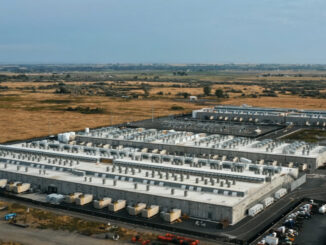
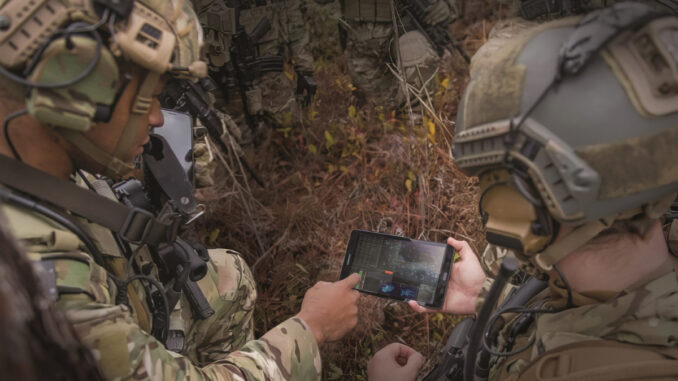
The U.S. military is undergoing a decisive architectural shift: moving artificial intelligence away from distant cloud data centers and pushing it toward edge and fractal computing models that operate directly where missions unfold.
This transition is driven by a simple operational truth—speed, survivability, and decision advantage cannot depend on fragile, long‑haul connectivity.
For decades, cloud‑based AI promised scalable compute power, but modern conflict—defined by electronic warfare, dispersed forces, and disconnected, disrupted, intermittent, and limited (DDIL) communications—has exposed its limits. Tactical units cannot wait for data to travel thousands of miles to a cloud server and back. As DefenseScoop reports, commanders in the Indo‑Pacific increasingly face environments where cloud reach‑back is “outmoded and unreliable,” making real‑time edge intelligence a strategic necessity.
Why Cloud‑Centric AI Is No Longer Enough
Data Center Cloud AI struggles in military environments for four core reasons:
- Latency: Mission‑critical tasks—like threat detection, targeting, or mine‑hunting—cannot tolerate seconds of delay. Latency can be catastrophic, as shown in naval AI deployments where seabed mine detection must occur instantly, not after a cloud round‑trip.
- Bandwidth limits: Modern sensors generate massive data volumes. A single smart industrial system can produce petabytes per week—far beyond what can be pushed to the cloud in contested environments.
- Vulnerability: Cloud‑dependent architectures rely on centralized hubs that are easily jammed, spoofed, or cut off—failure modes extensively documented in RAND’s research on JADC2 and centralized C2 architectures.
- Security and compliance: Even commercial cloud platforms often fail to meet DoD IL5 security requirements, forcing hybrid or local alternatives for sensitive workloads.
These constraints have pushed the Pentagon toward architectures that compute where the mission happens.
Edge and Fractal Computing: The New Model
Edge AI processes data directly on deployed platforms—drones, vehicles, ships, satellites, or soldier‑carried devices—allowing units to act on intelligence even when disconnected. As Dataversity notes, edge AI “delivers mission insights where connectivity is limited or intermittent,” using lightweight, mission‑tuned models that operate independently of cloud infrastructure .
Fractal computing, meanwhile, extends this concept by designing systems so that every node—large or small—functions as a self‑similar, autonomous micro‑data‑center. Defense research institutions such as the Hudson Institute and RAND describe this as an architectural solution to the latency and survivability problems inherent in centralized command‑and‑control: the force that moves from sensor to decision fastest wins, and that speed is an architecture problem, not a hardware problem .
Together, edge and fractal architectures create a distributed, resilient, self‑healing AI ecosystem.
Operational Advantages in the Field
1. Real‑time decision superiority
Edge AI gives warfighters immediate access to fused intelligence. DefenseScoop emphasizes that information superiority now depends on “delivering real‑time insights to warfighters in DDIL environments” rather than relying on distant cloud analysis .
2. Survivability under attack
Distributed architectures eliminate single points of failure. RAND’s JADC2 research shows that hub‑and‑spoke cloud models collapse under contested electromagnetic conditions, while decentralized edge nodes continue operating independently .
3. Faster model updates and autonomy
The Navy’s AMMO program demonstrated a 97% reduction in AI model update time by shifting to edge‑first deployment—cutting update cycles from months to days .
4. Reduced bandwidth and logistics burden
Processing data locally avoids saturating limited tactical networks and reduces reliance on vulnerable satellite links.
5. Security that travels with the mission
Edge systems increasingly use hardware‑rooted security, encryption, and confidential computing to protect sensitive workloads even when disconnected from secure cloud environments .
The Strategic Bottom Line
The shift from cloud‑centric AI to fractal and edge AI is not a technological preference—it is a strategic imperative. Modern warfare rewards forces that can sense, decide, and act faster than their adversaries, even when communications are degraded. Cloud AI cannot meet that requirement. Edge and fractal architectures can.
The U.S. military is therefore building a future where AI lives at the point of conflict, not in a distant data center.
Sources:
- DefenseScoop – The New Frontline: Winning the Information War at the Tactical Edge https://defensescoop.com
- Fractal Defense Resources – Edge-Dominant Architecture & JADC2 Analyses (Hudson Institute, RAND, CRS) https://fractaldefense.com/resources
- Latent AI – From Cloud-First to Edge-First: The Future of Enterprise AI (Cloud to Edge White Paper) https://latentai.com
- Cyber Defense Magazine – Powering AI at the Tactical Edge https://cyberdefensemagazine.com
- Dataversity – Designing Edge AI That Works Where the Mission Happens https://dataversity.net
Wyoming Data Center Facts | Photo:Photo: US Air Force Materiel Command