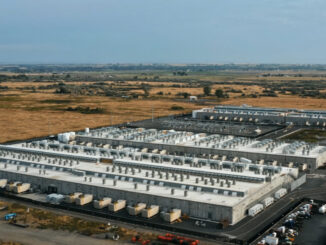
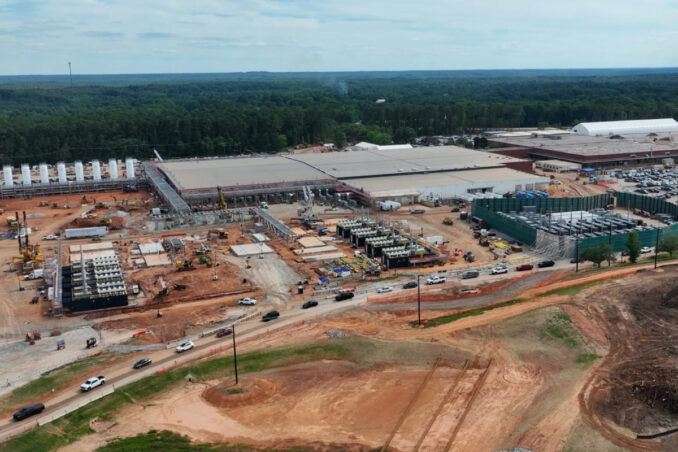
Why Wyoming Should Pay Attention: As data center developers target Wyoming communities, they bring a standardized playbook for securing zoning and water permits. The NorthMark Compute “Valara” facility in Spartanburg County, South Carolina, serves as a textbook example of how developers use deceptive terminology to hide massive water consumption until it is too late to stop construction.
Here is a breakdown of what the developer claimed versus what was actually built.
The “Not a Data Center” Disguise
- The Pitch: Developers initially insisted the facility was “not a data center” but a private “computing facility” for advanced math, science, and manufacturing research.
- The Reality: High-Performance Computing (HPC) and AI server farms are some of the most energy and water-intensive data centers on the planet. By changing the label, developers attempted to dodge the heavy scrutiny normally applied to data center infrastructure.
The Water Usage Mirage
- The Initial Numbers: To secure early approvals, the developers claimed they would operate under the water permit of the site’s previous tenant (an old Kohler manufacturing plant). In early 2026, they submitted a Phase I survey projecting water use at 459,400 gallons per day.
- The Full Buildout Reality: In September 2026, long after the project was in motion, NorthMark publicly admitted the facility will actually require an average of 1.2 million gallons daily, with peak demand hitting 1.6 million gallons.
- The Timeline Trap: Developers disclosed the 1.6 million gallon peak to the local utility seven months before the public was finally informed of the massive increase.
The “Closed-Loop” Deception
- The Pitch: Developers assured the public the facility would utilize a “closed-loop system, like the radiator in your car,” implying virtually zero water consumption.
- The Reality: They were only describing the internal server plumbing (the Technology Cooling System or TCS). The exterior heat-rejection infrastructure (the Facility Cooling System or FCS) actually relies on massive open-loop evaporative cooling towers to dump the heat. A true “car radiator” system consumes no water; Valara’s system uses up to 1.6 million gallons a day.
The Adiabatic Trap (The “Dry Cooler” Loophole)
Even when developers genuinely use closed-loop exterior dry coolers, they often omit the “adiabatic assist” systems from their public presentations.
- How it Works: When summer temperatures spike, dry coolers cannot shed enough heat. Adiabatic cooling systems operate by pre-cooling the outside air before it reaches the heat exchanger coils. This is achieved either by spraying a fine water mist directly into the intake airstream or by drawing the air through wetted evaporative media pads. As the water evaporates, it absorbs heat from the air, dropping the incoming air temperature. This allows the dry cooling fins to continue functioning during high-heat days, but it triggers massive water consumption precisely when local temperatures peak.
- The Threat: This forces local municipalities to supply millions of gallons of water precisely during peak summer heatwaves when residential drought restrictions are already in effect.
Takeaways for Wyoming Municipalities
- Demand Exact Definitions: Never accept the term “closed-loop” without a legally binding definition that applies to the exterior Facility Cooling System (FCS), not just the internal IT loop.
- Require “Full Buildout” Projections: Do not approve zoning based on “Phase I” or “annual average” water estimates. Demand absolute maximum peak-day water usage at full operational capacity.
- Check the Heat Rejection Tech: Explicitly ask if the exterior system utilizes evaporative cooling towers, wetted media pads, or adiabatic spray bars. If the answer is yes, it is not a zero-water system.
Sources:
-
Valara Data Center: $2.8B Spartanburg HPC Project & Status
Data Center News covers the initial announcements, scale of the $2.8 billion facility at the old Kohler plant, and the environmental permitting for the 457-megawatt on-site power generation.
Link: https://datacenternews.org/valara-data-center-spartanburg-south-carolina/
-
Spartanburg Data Center Water Use Projections Increase
Here Clinton News reported on the recent admissions by NorthMark Compute that the full buildout of the Spartanburg facility will consume an average of 1.2 million to a peak of 1.6 million gallons of water daily, a steep increase from the 459,000 gallons initially projected in the Phase I wastewater survey.
Link: https://www.hereclinton.com/2026/09/22/spartanburg-data-center-water-use-projections-increase/
-
After SC data center’s projected water use ballooned, it took months to tell public
The Post and Courier Spartanburg investigated the timeline of the water usage discrepancy, confirming that NorthMark had provided the 1.2M – 1.6M gallon figure to the water utility in February 2026, but the public was not informed until seven months later.
-
What to know about Spartanburg’s NorthMark data center
The Post and Courier earlier coverage detailing the initial plans to convert the former Kohler plant (which closed in 2024) into a self-powered high-performance computing facility.
-
AI Data Centers Face $68 Billion Wave of Community Opposition
Gadget Review contextualizes the Spartanburg Valara facility’s 1.6-million-gallon water issue within the broader national backlash against AI data centers draining community utility resources.
Link: https://www.gadgetreview.com/ai-data-centers-face-68-billion-wave-of-community-opposition
ASHRAE Technical Committee (TC) 9.9: Thermal Guidelines for Data Processing Environments
-
What it covers: ASHRAE (American Society of Heating, Refrigerating and Air-Conditioning Engineers) TC 9.9 is the global authority on data center thermal management. Their guidelines establish the exact engineering definitions for liquid cooling loops. Specifically, they define the strict separation between the internal Technology Cooling System (TCS)—the sealed loop touching the IT equipment—and the external Facility Cooling System (FCS)—the loop that takes heat to the outdoor cooling towers or dry coolers.
-
Relevance: This is the gold-standard source to prove that just because a data center uses a “closed loop” on the inside (TCS) does not mean it uses a waterless system for heat rejection on the outside (FCS).
Baltimore Aircoil Company (BAC) Data Center Heat Rejection White Papers
-
What it covers: BAC is one of the world’s largest manufacturers of industrial heat rejection equipment for data centers. Their technical resources provide detailed mechanical breakdowns distinguishing between Evaporative Cooling (cooling towers that evaporate water for extreme energy efficiency), Dry Cooling (closed-circuit sensible coolers that use zero water but more electricity), and Adiabatic Cooling (hybrid dry coolers that spray water over pads only during hot design days to pre-cool the air).
-
Relevance: Equipment manufacturers like BAC and Evapco write the engineering white papers that developers use to design these sites. Their documentation clearly outlines how adiabatic systems create a massive peak-demand water draw during summer heatwaves, contradicting claims of “zero water” cooling.
U.S. Department of Energy (DOE) – Federal Energy Management Program (FEMP) & Center of Expertise for Energy Efficiency in Data Centers
-
What it covers: Operated in conjunction with the National Renewable Energy Laboratory (NREL) and Lawrence Berkeley National Laboratory (LBNL), this DOE program provides best practices for data center water and energy efficiency. Their research thoroughly details Water Usage Effectiveness (WUE) and the trade-offs between closed-loop dry coolers (which save water but use more compressor energy) versus evaporative systems (which save energy but consume millions of gallons of water).
-
Relevance: The DOE provides objective, government-backed analysis showing how data centers utilizing evaporative or adiabatic methods continuously consume water through evaporation and blowdown (purging mineral scale), debunking the myth that a facility using cooling towers can be considered a strictly “closed-loop” zero-waste system.
Wyoming Data Center Facts | Photo: Photo: WSPA News