A Line in the High Plains: Natrona County Rejects Regulatory Bypass for Prometheus Hyperscale
The Natrona County Board of Commissioners has firmly rejected a regulatory maneuver that would have allowed the massive, proposed Prometheus Hyperscale AI data center and power generation project to bypass state-level environmental and socioeconomic oversight.
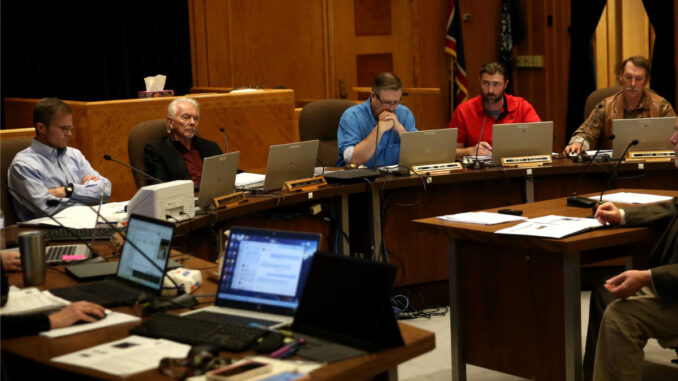
In a decisive Tuesday meeting, county leaders opted against creating a specialized industrial park designation, choosing instead to leave primary oversight in the hands of the Wyoming Industrial Siting Council (ISC). The move slows down a project that represents one of the most complex industrial proposals in the state’s history, signaling that local officials will not fast-track hyperscale development at the expense of their constituents.
Rejecting the Industrial Park Bypass
The discussion arose after Natrona County Development Director Sabrina Kemper and County Attorney Ashley Smith sought guidance regarding inquiries from Prometheus developers. Under Wyoming statute, the county could technically establish an industrial park through a Planned Unit Development (PUD) process. Doing so would effectively strip the Wyoming ISC of jurisdiction, leaving the regulatory burden entirely on local government resources.
Commissioners flatly declined to take on that responsibility, expressing a clear preference for the state’s rigorous evaluation framework.
“I don’t really have a lot of interest in doing industrial parks,” stated Commissioner Casey Coates. “I really like the industrial siting process. I think it gives a more robust ability to scrutinize projects where I don’t think our county has the ability to scrutinize them to the level that data centers require.”
Commissioner Peter Nicolaysen echoed this caution, noting that placing such massive developments broadly across county zoning districts without state-level expertise is highly problematic. “I just think that it is maybe getting us into a place where we don’t have the competency and expertise,” Nicolaysen said.
The physical footprint of the project is massive and split across county lines. Current plans indicate that the data center buildings themselves—a planned first phase consisting of five 500,000-square-foot structures—would likely be located in neighboring Converse County. However, Natrona County is the proposed site for the project’s dedicated power generation facility and workforce man-camp.
Commissioner Dave North pointed to cautionary tales elsewhere in the state, specifically referencing the rapid, blanket zoning expansions seen in Cheyenne. “I don’t want to be in the same boat that Cheyenne is where they’re making these big blanket areas,” North said, emphasizing that the county must maintain specific control over what it allows.
Deep Skepticism Over Rural and Agricultural Encroachment
A central theme of the commissioners’ opposition was the fundamental incompatibility of a massive industrial footprint with rural residential families, farms, and ranches.
To gauge community sentiment, Commissioner Dallas Laird conducted an informal poll of the meeting room. The result was lopsided and definitive: dozens of attendees signaled strict opposition, while only three hands were raised in favor—all belonging to representatives of Prometheus Hyperscale. Even when Laird asked if residents would object if the project did not directly border their own property lines, the room remained overwhelmingly opposed to introducing this scale of industrialization into agricultural zones.
Commissioner Laird offered a blunt assessment to close out the discussion:
“I am for economic development. I’m not for economic development that hurts our people.”
Frontline Voices: Landowners and Ranchers Speak Out
Residents living east of Casper near the proposed site turned out in force to voice concerns over groundwater depletion, noise pollution, air polution, and the destruction of their livelihoods.
-
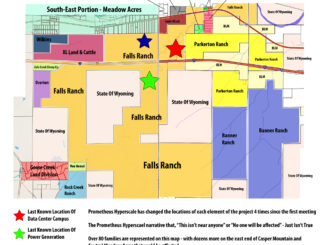
Kris Hool presented a map to the commissioners, directly challenging claims by developers that the area is largely uninhabited. Hool argued that the project is being rushed and desperately needs the scrutiny of the state’s industrial siting process, including professional, independent scientific studies of air, noise, and water impacts.
-
Sarah Collins, a fourth-generation livestock producer, expressed deep concern over the local water aquifers that her family and cattle rely upon, noting that hyperscale infrastructure poses an existential threat to historical wells.
-
Brad Isner focused on the sheer physical scale of the project, “They’re not bringing us anything,” Isner said. “They’re just going to take our property, devalue it, pollute it.”
-
Betty Mosley described the emotional and environmental toll of industrializing the prairie where she rides her horse and watches pronghorn raise fawns, criticizing the developers’ approach. “How can you be so pompous as to think you’re going to improve upon what God has given us?” she asked.
-
Margaret Isner noted that the pushback in Wyoming mirrors a national trend, pointing out that other states are actively backpedaling on fast-tracking data centers due to unforeseen resource strain.
Technical and Strategic Risks:
Speaking after the meeting, Kevin Hool strongly backed the commissioners’ decision to slow the project down, providing a detailed breakdown of the environmental and economic risks associated with the facility’s power requirements.
“This is a major win for the people of Natrona and Converse Counties,” Hool said. “A project of this scale brings enormous risks. Most residents have never seen what 150 Jenbacher J620 natural‑gas generators—plus more than a hundred diesel backups or even larger gas turbines—do to air and water quality.”
Hool warned that central Wyoming’s unique geography exacerbates these threats:
“In a mountain basin like central Wyoming, winter inversions trap emissions close to the ground. Our preliminary modeling shows PM2.5 levels, both 24‑hour and annual, far outside EPA Clean Air Act thresholds. And the ‘scrubbing’ systems these companies promote don’t solve the problem; they concentrate pollutants into waste streams that still end up in our air and water. With a generator farm of this density, Casper and the residents of Natrona and Converse counties could experience the worst air quality in the state and, on many days, among the worst air quality in the nation.”
Hool also questioned the long-term economic viability of the centralized hyperscale AI business model, suggesting that state leadership is failing to see where artificial intelligence technology is actually moving.
Hool stated. “The industry is rapidly advancing toward highly efficient, localized ‘Edge’ servers, desktops, laptops, and handheld AI computing technology that doesn’t require these massive, centralized hyperscale facilities. Many public officials don’t seem to understand that the hyperscale build-out is currently burning billions in borrowed cash with no clear path to profitability. When Wall Street eventually realizes the math doesn’t add up, what happens to Wyoming if we’ve sacrificed our clean air, clean water, trillions of cubic feet of natural gas, and the Wyoming way of life for a collapsing business model?”
Hool finished with, “We can debate whether the country even needs hyperscale facilities at the scale they’re being built, but we should never have to debate whether to put them in the middle of where families live. That is simply wrong — and the people pushing these projects know it. I think our commisioners showed tonight that people, and families lives still matter, and I can’t thank them enough….and there are communites all across the nation that wish these were their commisioners.”
The Dual-Track Regulatory Gauntlet
By refusing the PUD industrial park designation, the commissioners have forced Prometheus into a complex state-and-local regulatory framework. While primary technical review shifts to Cheyenne, the final authority to approve or deny the project remains entirely with the commissioners of Natrona and Converse counties.
The mandatory regulatory tracks Prometheus must now pursue include:
1. State-Level Scrutiny Under the Industrial Siting Act
Prometheus must formally apply for a Section 109 permit through the Wyoming ISC. This statutory process forces the developer to fully fund independent, professional studies to quantify socio-economic and environmental impacts. Natrona and Converse counties will participate as formal parties to the hearings. As County Attorney Ashley Smith noted, this ensures the counties “have a seat at the table” to demand robust mitigations rather than simply reacting to infrastructure strain.
2. Environmental Quality and Ratepayer Protection
Because of the massive co-located power generation required to run a 500 MW compute campus, Prometheus must secure strict air quality and emissions permits from the Wyoming Department of Environmental Quality (DEQ).
Furthermore, drawing the massive volume of natural gas required to fuel 150+ industrial generators impacts regional pipeline infrastructure and “citygate” pricing. Without completely segregated infrastructure and dedicated supply lines, an industrial draw of this magnitude risks exposing residential ratepayers on local “Choice Gas” programs to severe winter price shocks—potentially spiking heating costs by up to 300% during extreme weather events.
3. Local Zoning and Land-Use Approval
Even if a project successfully navigates the ISC and the DEQ, state agencies cannot override local land-use laws. To build the data center campus, power plant, or worker housing, Prometheus must obtain Conditional Use Permits (CUPs) and zoning amendments from both Natrona and Converse county commissioners.
| Regulatory Body | Primary Oversight Area | Local Veto Power? |
| Industrial Siting Council (ISC) | Socioeconomic impacts, macro infrastructure, regional resource strain. | No (Grants state-level industrial permit). |
| Department of Environmental Quality (DEQ) | Air quality permits ($PM_{2.5}$ emissions), water discharge, waste streams. | No (Technical environmental compliance). |
| County Commissioners (Natrona/Converse) | Zoning amendments, Conditional Use Permits (CUPs), local road/development agreements. | Yes. Can deny land use entirely based on local impact. |
Because these local land-use decisions must be executed in strict compliance with the Public Meetings Act, area ranchers and homeowners are guaranteed a continuing, transparent forum to challenge every permit. If Prometheus fails to prove that it can protect the local way of life, the local water wells, prevent air quality degradation, and isolate its energy footprint from residential utility bills, the commissioners retain the absolute legal authority to deny local permits, halting the project permanently.
Wyoming Data Center Facts |Photo: Tommy Culkin – Oil City News