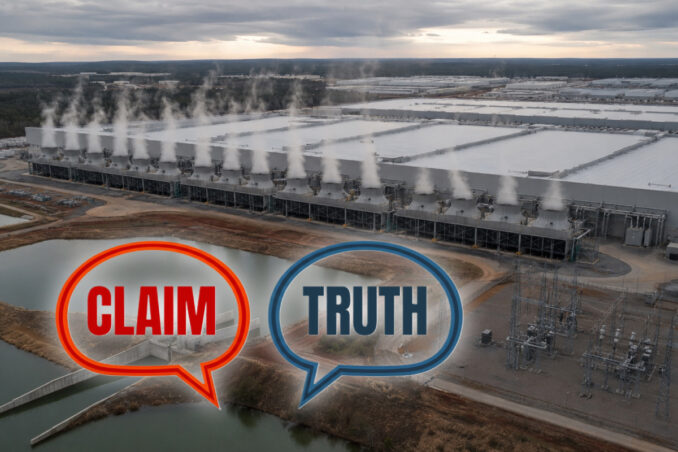
Claim:
“Closed‑loop” systems in hyperscale AI data centers don’t use water.
Truth:
The term “closed‑loop” is a marketing label, not a measure of water use. In practice, it refers only to the sealed coolant circuit inside the data hall and the primary loop that carries heated coolant outdoors for heat rejection. It says nothing about whether the facility consumes water.
Water use comes from the heat‑rejection system, not the IT loop. Evaporative cooling towers, evaporative‑assist dry coolers, and evaporative‑assist chillers are what consume water—because they reject massive amounts of heat by evaporating it into the atmosphere.
Modern AI data centers are huge and extremely power‑dense. Since 2024, the average hyperscale AI building in the U.S. is 400,000–600,000 sq ft and designed for 80–120MW of IT load. A 500,000 sq ft / 100MW hall is now the industry norm.
High‑density AI halls over ~50MW cannot be cooled without water. AI racks routinely draw 40–100kW per rack, creating heat loads that dry coolers and air‑cooled chillers cannot dissipate. Only water‑based evaporative systems can reject this level of heat.
Hall size, chip deployment, and rack density determine water use. A single 100MW hall—with concentrated chip TDP and extreme rack density—must use water.
Dry cooling is physically impractical at hyperscale AI loads. To reject hundreds of megawatts of thermal energy using only ambient air, the dry coolers or air‑cooled condensers would require more physical acreage than the data halls themselves. Worse, they would consume hundreds of megawatts of fan power—power the hall needs for training and inference, not cooling. This makes air‑only cooling infeasible for modern AI deployments.
Bottom Line:
A “closed loop” label doesn’t reveal whether a data center uses water. The size of the hall, the chips deployed, the rack density, and the heat‑rejection method determine water consumption. Today’s AI halls are so large and so dense that water‑based cooling is unavoidable.
Sources:
Closed‑Loop Cooling Does Not Indicate Water Use
- ASHRAE TC 9.9 — Liquid Cooling Guidelines
https://www.ashrae.org/technical-resources/technical-committees/tc-9-9 - Uptime Institute — Water and Sustainability Research https://uptimeinstitute.com/research
- Lawrence Berkeley National Laboratory — Data Center Efficiency Research
https://eta.lbl.gov/datacenters
Water Use Comes From Heat‑Rejection Systems
- DOE Better Buildings — Data Center Cooling Technologies
https://betterbuildingssolutioncenter.energy.gov/data-center - ASHRAE — Cooling Tower Fundamentals
https://www.ashrae.org/technical-resources/bookstore - EPA ENERGY STAR — Data Center Cooling Overview
https://www.energystar.gov/products/data_center_equipment
Modern AI Data Center Size & Power (2024–2026 Builds)
- Meta Data Center Design & Construction
https://datacenters.meta.com - Microsoft Data Center Development
https://www.microsoft.com/en-us/datacenters - Google Data Center Locations & Infrastructure
https://www.google.com/about/datacenters - AWS Global Infrastructure
https://aws.amazon.com/about-aws/global-infrastructure - CBRE Data Center Market Reports https://www.cbre.com/insights
- JLL Data Center Trends
https://www.us.jll.com/en/trends-and-insights/research
AI Rack Density (40–100kW per Rack)
- NVIDIA DGX/HGX Systems
https://www.nvidia.com/en-us/data-center - Dell Technologies Liquid‑Cooled AI Racks
https://www.dell.com/en-us/dt/solutions/data-centers - HPE High‑Density Compute
https://www.hpe.com/us/en/servers.html - Supermicro Liquid Cooling Solutions
https://www.supermicro.com/en/products/liquid-cooling
Hall Size, Chip Deployment, Rack Density Determine Water Use
- DOE & LBNL High‑Density Cooling Studies https://www.energy.gov/eere/buildings
- Uptime Institute — Cooling & Heat Rejection Guidance https://uptimeinstitute.com/research
- ASHRAE — Datacom Cooling Best Practices
https://www.ashrae.org/technical-resources/bookstore
Dry Cooling Impractical at 100MW+ AI Loads
- ASHRAE — Air‑Side Economization Limits
https://www.ashrae.org/technical-resources/bookstore - DOE — Air‑Cooled Condenser Performance https://www.energy.gov/eere/amo
- Utility Case Studies (Dominion, NV Energy, PG&E) https://www.dominionenergy.com https://www.nvenergy.com https://www.pge.com
Wyoming Data Center Facts |