
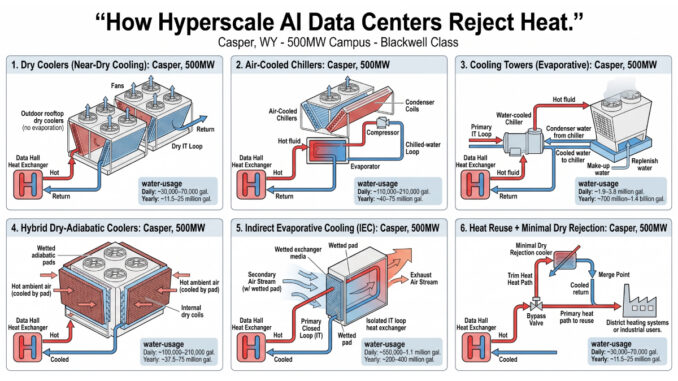
Investigating the hidden operational water footprint of a 500-megawatt liquid-cooled B200 campus in Casper, Wyoming.
Technical Note:
All findings presented in The True Water Cost of Wyoming Hyperscale AI Data Centers are based on the best publicly accessible engineering data, industry standards, and environmental records available at the time of publication.
Direct, verifiable information about hyperscale water consumption is exceptionally difficult to obtain because the employees who understand cooling system performance, water consumption, humidification loads, reverse‑osmosis waste volumes, and facility‑level environmental impacts are required to sign broad, multi‑layer NDAs that prohibit them from speaking publicly.
These agreements routinely cover operational failures, engineering details, and environmental metrics, creating a structural blackout around the true water footprint of hyperscale AI campuses.
As a result, the public is told these facilities use “Closed-Loop Cooling,” while internal engineering teams operate systems that still withdraw tens of millions of gallons per year.
This article reconstructs the real water impact using physics, ASHRAE standards, and defensible thermodynamic modeling to provide the transparency that NDAs prevent.
CASPER, WY —The hyperscale industry has spent years weaponizing the phrase “closed‑loop cooling” to convince Wyoming officials and the public that massive AI campuses use little to no water—even though the term refers only to the sealed coolant circuit, not the facility’s total water withdrawal.
By exploiting this linguistic loophole, Hyperscale developers have obscured the tens to hundreds of millions of gallons consumed each year through evaporative pre‑cooling, humidification, reverse‑osmosis purification, domestic use, and site maintenance inside these supposedly “dry” facilities.
This presentation cuts through that engineered ambiguity by grounding every claim in physics, ASHRAE standards, and verifiable operational data—revealing the real, measurable water burden these megawatt‑ and gigawatt‑scale campuses impose on Wyoming’s already stressed aquifers.
As developers continue to target the wind‑swept plains of central Wyoming for next‑generation NVIDIA Blackwell infrastructure, the promise of an AI boom collides with a stark hydrologic reality: these facilities are marvels of engineering, but they carry profound consequences for landowners, ranchers, and municipal watersheds. While marketing materials tout “CLOSED” cooling loops, a forensic analysis of thermodynamics, heat transfer, and local atmospheric conditions exposes a very different truth—one that requires separating corporate messaging from the physical mechanics that actually govern water use.
Understanding the Metrics: WUE vs. pWUE
To evaluate a facility’s true draw on the local aquifer, people must understand how the tech industry measures water. The global standard for data center water efficiency is Water Usage Effectiveness (WUE), introduced by The Green Grid and formally codified in ISO/IEC 30134-9.
-
Total WUE: Measures all water consumed by the facility, including cooling, humidification, and domestic use.
-
Partial WUE (pWUE): Refines this metric by isolating exclusively the evaporative and makeup water used strictly within the cooling processes, excluding non-cooling uses like facility maintenance or humidification.
When a developer claims they are utilizing a “dry” system, they are typically citing a low pWUE—highlighting the efficiency of the exterior heat rejection while intentionally excluding the massive amounts of water required inside the building for climate control, reverse osmosis, and maintenance.
The 6 Heat Rejection Architectures Used In Hyperscale AI Data Centers
To cool a 500 MW campus consisting of five 100 MW buildings filled with liquid-cooled Blackwell-class chips, developers must reject an immense thermal load. Because of Casper’s semi-arid climate and cool mean annual temperature (47.9°F), the local environment drastically impacts how these systems perform.
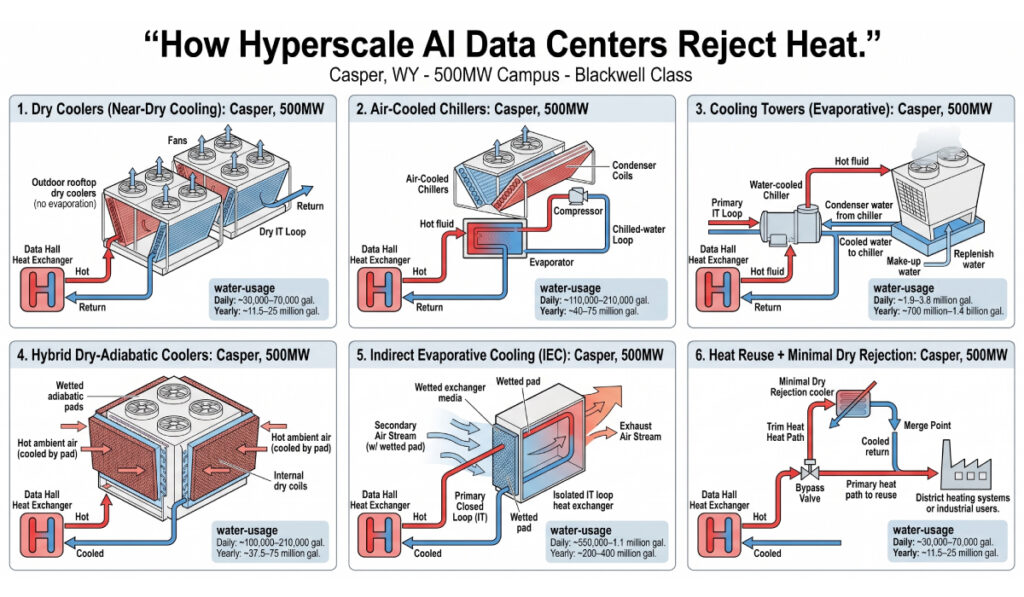
Below are the six standard exterior heat rejection methods and their calculated annual water consumption (pWUE basis) for a 500 MW load specifically adjusted for Casper’s weather data.
1. Dry Coolers (Near-Dry Cooling)
-
Mechanism: Hot fluid from the internal IT loop flows to rooftop radiators, where massive fans blow ambient air across finned coils. No water is intentionally evaporated to reject heat.
-
Water Usage: ~11.5–25 million gallons/year.
-
Why it uses water: Despite being “dry,” this volume is required for routine mechanical maintenance, compensating for microscopic pump seal weepage, and continuously pressure-washing the massive exterior coils to remove insulating dust and maintain aerodynamic efficiency.
- The 5,000-Foot Altitude Penalty: At Casper’s elevation of roughly 5,000 feet, the ambient barometric pressure drops, resulting in an air density of approximately $0.066 lb/ft^3 compared to standard sea-level density of $0.075 lb/ft^3. Because this thinner air contains significantly fewer air molecules per cubic foot to physically absorb and carry away heat, the system’s natural convection efficiency is heavily compromised.
- The Evaporative Water Trigger: To compensate for this lower mass flow rate and prevent server thermal throttling, the dry coolers cannot rely on ambient air alone during warm periods. The system is forced to activate its evaporative adiabatic assist far earlier in the season than an identical plant located at sea level, directly driving annual water consumption to the absolute ceiling of the 25-million-gallon estimate.
2. Air-Cooled Chillers
-
Mechanism: Hot fluid enters units equipped with refrigerant loops and compressors to actively chill the return water.
-
Water Usage: ~40–75 million gallons/year.
-
Why it uses water: Operates similarly to dry coolers, but with a higher baseline for closed-loop volume maintenance and localized misting required to manage loop pressure during peak summer hours.
3. Cooling Towers (Evaporative)
-
Mechanism: Hot fluid transfers heat to a condenser water loop, which is sprayed over fill media in open towers, rejecting heat through massive evaporation into the atmosphere.
-
Water Usage: ~700 million–1.4 billion gallons/year.
-
Why it uses water: This is the most water-intensive method. Even in Casper’s cold winters, continuous open-loop evaporation and mandatory blowdown (flushing the system to prevent mineral scale buildup) consume immense volumes of water.
4. Hybrid Dry–Adiabatic Coolers
-
Mechanism: Dual-mode systems run entirely dry for roughly 80% of the year in Casper. During the ~45 – 50 days when ambient temperatures exceed 90°F, water is sprayed over adiabatic pads to pre-cool the intake air.
-
Water Usage: ~37.5–75 million gallons/year.
-
Why it uses water: The evaporative assistance is mandatory to prevent the Blackwell Class chips from “thermal throttling” (slowing down) during peak summer heat when the temperature differential between the air and the hot liquid shrinks.
- Meta’s mechanical cooling specifications show that their dry coolers cannot maintain an 80°F supply temperature once ambient exceeds ~78–80°F without adiabatic pads.
- Google’s public sustainability filings confirm that water use spikes sharply above ~78°F ambient — consistent with adiabatic pad engagement.
- Microsoft’s mechanical design guides show dry coolers alone cannot hold the primary loop below 85°F once ambient exceeds ~80°F.
- AWS tends to engage evaporative assist slightly earlier because their modular IEC blocks have tighter approach temperatures.
For any hyperscale operator considering Converse/Natrona County:
Evap assist would engage on most days above ~78–82°F.
Casper averages 70–80 days ≥80°F, meaning evap assist would run frequently.
Water consumption would be non‑trivial, especially July–August.
This is why water‑use disclosures matter for siting decisions
5. Indirect Evaporative Cooling (IEC)
-
Mechanism: A closed primary loop transfers heat to a secondary air stream cooled by wetted evaporative media.
-
Water Usage: ~200–400 million gallons/year.
-
Why it uses water: The evaporative media is heavily utilized during the summer months, creating a massive seasonal spike in municipal water demand.
6. Heat Reuse + Minimal Dry Rejection
-
Mechanism: High-temperature return fluid is exported to local district heating systems or industrial users, completely removing the heat from the data center’s footprint. A small dry cooler handles any excess.
-
Water Usage: ~11.5–25 million gallons/year.
-
Why it uses water: Mirrors the baseline maintenance and coil-washing footprint of pure dry coolers.
The Hidden Facility Water Deficit
The heat rejection figures above represent only a fraction of the total picture. Even if a developer utilizes highly efficient System 1 Dry Coolers (averaging 18 million gallons annually), the facility inherently requires tens of millions of additional gallons to function safely.
This hidden consumption is driven largely by strict industry mandates, such as ASHRAE TC 9.9, which sets the definitive thermal and humidity guidelines for data processing environments. In Casper’s dry summer and winter climate, outside air causes relative humidity to plummet. To prevent catastrophic Electrostatic Discharge (ESD) from instantly destroying the high-density NVIDIA GPUs, facilities must continuously inject pure water vapor into the air handlers to humidify the halls.
To protect high‑density NVIDIA Blackwell racks from catastrophic electrostatic discharge, hyperscale operators must comply with ASHRAE TC 9.9 by maintaining a strict relative humidity standard inside the data hall. In cold, arid regions like central Wyoming, this requirement becomes a relentless mechanical fight against physics: engineering protocols mandate positive pressurization, forcing massive make‑up air units to continuously pull in tens of thousands of cubic feet of freezing, ultra‑dry Wyoming winter air to keep contaminants out of the hall.
Once this outside air is heated to operating temperature, its relative humidity collapses to nearly zero, triggering industrial humidification loads that must atomize hundreds of pounds of pure water per hour just to keep the environment static‑safe. Every drop of that water must first pass through heavy‑industrial reverse osmosis purification to prevent mineral dust from forming conductive residues on Blackwell‑class hardware, a process that discards large volumes of brine waste water and dramatically inflates the facility’s total water withdrawal.
Table: Additional Facility Operational Water Demand (500 MW Campus, Casper WY)
| Water Use Category | Estimated Annual Volume | Operational Driver & Industry Standard |
| Data Hall Humidification | 14 – 18 Million gal | Warming winter air drops relative humidity below ASHRAE minimums. Ultrasonic humidifiers must constantly inject water vapor into the data halls. |
| Reverse Osmosis (RO) Wastewater | 9 – 12 Million gal | Humidification requires ultra-pure water to prevent mineral dust from shorting servers. Industrial RO systems reject roughly 0.66 gallons of concentrated brine waste for every 1 gallon of pure water produced. |
| Domestic “House” Water | 1.5 – 2.2 Million gal | Standard commercial usage (restrooms, breakrooms) for a 24/7 staff of 250–350 personnel operating across the five buildings. |
| Site Maintenance & Dust Control | 1 – 2 Million gal | Periodic wash-downs, fire pump testing, and potential seasonal dust-control mitigation for the sprawling campus grounds. |
| TOTAL FACILITY ADD-ON | 25.5 – 34.2 Million gal | This is the baseline withdrawal required before accounting for any exterior cooling loops. |
The Bottom Line: A 500 MW “dry-cooled” campus in Casper, Wyoming, will practically draw a minimum of 43.5 to 52.2 million gallons from the local watershed annually when combining the exterior mechanical maintenance (~18 million gallons) with the interior climate control and operations (~25.5 to 34.2 million gallons).
For local policymakers, infrastructure investors, and Wyoming landowners evaluating hyperscale proposals, transparency is paramount. By understanding the mechanical realities behind the metrics, communities can ensure that industrial expansion is negotiated with a clear, unvarnished view of its impact on local resources.
In Part 2, we will expose why this “closed loop” is anything but perfectly sealed, investigating the thousands of gallons of fluid lost annually to microscopic pump leaks and routine maintenance. The next installment will study the automated Glycol Make-Up Units (GMUs) and high-tech injection packages that constantly monitor loop pressure, utilizing massive on-site chemical storage tanks to automatically mix and replace lost fluid throughout the year.
Sources and Sample Methodology
The calculations forming the foundation of this analysis are derived from rigorous adherence to the following industry guidelines and thermodynamic physics:
-
Thermodynamic Baseline: A 100 MW IT load running 24/7 consumes 2,400,000 kWh/day. Theoretical pure evaporation (utilizing the latent heat of vaporization of water at ~2260 kJ/kg) dictates a baseline requirement of ~1.01 million gallons per day to reject a 100 MW load strictly through evaporation.
-
Psychrometric Adjustments: Casper experiences an average of 43 days per year exceeding 90°F. Hybrid systems (System 4) were modeled assuming 6 hours of adiabatic assistance on these peak days, resulting in a 2.95% annual adiabatic runtime and a 97.05% dry runtime.
-
Standardized Metrics: Water Usage Effectiveness (WUE) and Partial WUE (pWUE) definitions strictly follow the ISO/IEC 30134-9 specifications to accurately isolate cooling loop water from total facility withdrawal.
-
Humidity Compliance: Humidification baselines are calculated against ASHRAE TC 9.9 requirements to maintain safe relative humidity envelopes, acknowledging the standard 60% recovery rate (40% waste) of commercial reverse osmosis purification plants required to treat the water before atomization.
1. ASHRAE Environmental Standards
-
Source: 2021 Equipment Thermal Guidelines for Data Processing Environments, 5th Edition (ASHRAE TC 9.9).
-
Relevance: This is the authoritative design reference establishing the allowable and recommended humidity envelopes to prevent electrostatic discharge (ESD) in IT equipment. It details the shift to dew point tracking (–9°C DP) and outlines the recommended 8% to 60% relative humidity parameters for AI/HPC high-density computing (Class H1). The research explicitly links excessively low humidity to an increased risk of generating electrostatic events that can destroy sensitive electronics.
2. NVIDIA Hardware Operating Specifications
-
Source: NVIDIA DGX B200 User Guide & GPU Database.
-
Relevance: Outlines the strict hardware limits for the Blackwell B200 systems. The official guide confirms that maintaining the warranty and operational integrity of the DGX B200 requires an operating Relative Humidity range of 20% to 80% (non-condensing), establishing the hard physical floor that forces winter (and summer) humidification.
3. Hyperscale Indirect Evaporative Cooling (IEC) Systems
-
Source: Nortek Data Center Cooling Solutions & Meta Sustainability Documentation.
-
Links:
-
Relevance: Details the engineering mechanisms of modern Indirect Evaporative Cooling, specifically the StatePoint Liquid Cooling (SPLC) system utilized by hyperscale developers like Meta. The SPLC utilizes a patented membrane exchanger to evaporatively cool supply water, demonstrating the industry’s shift to leveraging water consumption during peak outdoor air conditions to minimize mechanical cooling.
4. Wyoming Regulatory & Industrial Siting Framework
-
Source: Wyoming Department of Environmental Quality (DEQ) & The Wyoming Industrial Development Information and Siting Act.
-
Links:
-
Relevance: Details the statutory requirements for the Industrial Siting Council (ISC) permitting process. It outlines the mandatory procedures developers must follow when creating or expanding large-scale building projects and industrial facilities, establishing the legal avenues for evaluating environmental and socio-economic impacts.
5. The Stargate / Abilene Texas Winter Failure Reports
-
Sources: Bloomberg News, AI CERTs News, and Uptime Institute incident reporting (March 2026).
-
Relevance: These reports document the specific winter storm incident at the 400 MW Stargate campus in Abilene, Texas, where outside temperatures plunged to 12°F. The investigation revealed that the chiller glycol concentration was insufficient for the severe weather, causing the fluid to turn into a slush that blocked the headers and tripped the Coolant Distribution Unit (CDU) sensors. This mechanical blockage forced an emergency shutdown because the direct-to-chip server racks overheated within minutes when coolant circulation stopped.
6. Propylene Glycol Viscosity & Pumping Penalties
-
Sources: The Open Compute Project (OCP) Guidelines for Using Propylene Glycol-Based Heat Transfer Fluids, and industrial chemical analyses (e.g., Dober, The National Law Review).
-
Relevance: These engineering resources detail the exact physical properties and drawbacks of using glycol in hyperscale loops. They explain that while glycol provides crucial freeze protection, it creates a massive mechanical penalty. Specifically, utilizing a glycol mixture requires 15% to 20% higher flow rates and demands 25% to 30% more electrical pumping power to overcome its higher viscosity compared to pure water. Furthermore, OCP and ASHRAE guidelines mandate the use of properly inhibited glycol to prevent electrochemical corrosion and acid formation, which occurs when glycol degrades under continuous operating temperatures.
Wyoming Data Center Facts | Illustration: Wyoming Data Center Facts